

Table of Contents
TL;DR: Dog cooling mats are therapeutic tools designed to reduce a canine’s core temperature by 5 to 10 degrees through conduction or convection [6, 7]. In 2026, the Gen7Pets Cool-Air Cot remains the global standard for airflow, while Mindiam Pets’ Snooza Orthopaedic range is the top-tier recommendation for Australian owners managing hip dysplasia and UV exposure [8, 9].
The Science of Canine Thermodynamics: Managing the ‘150 Rule’
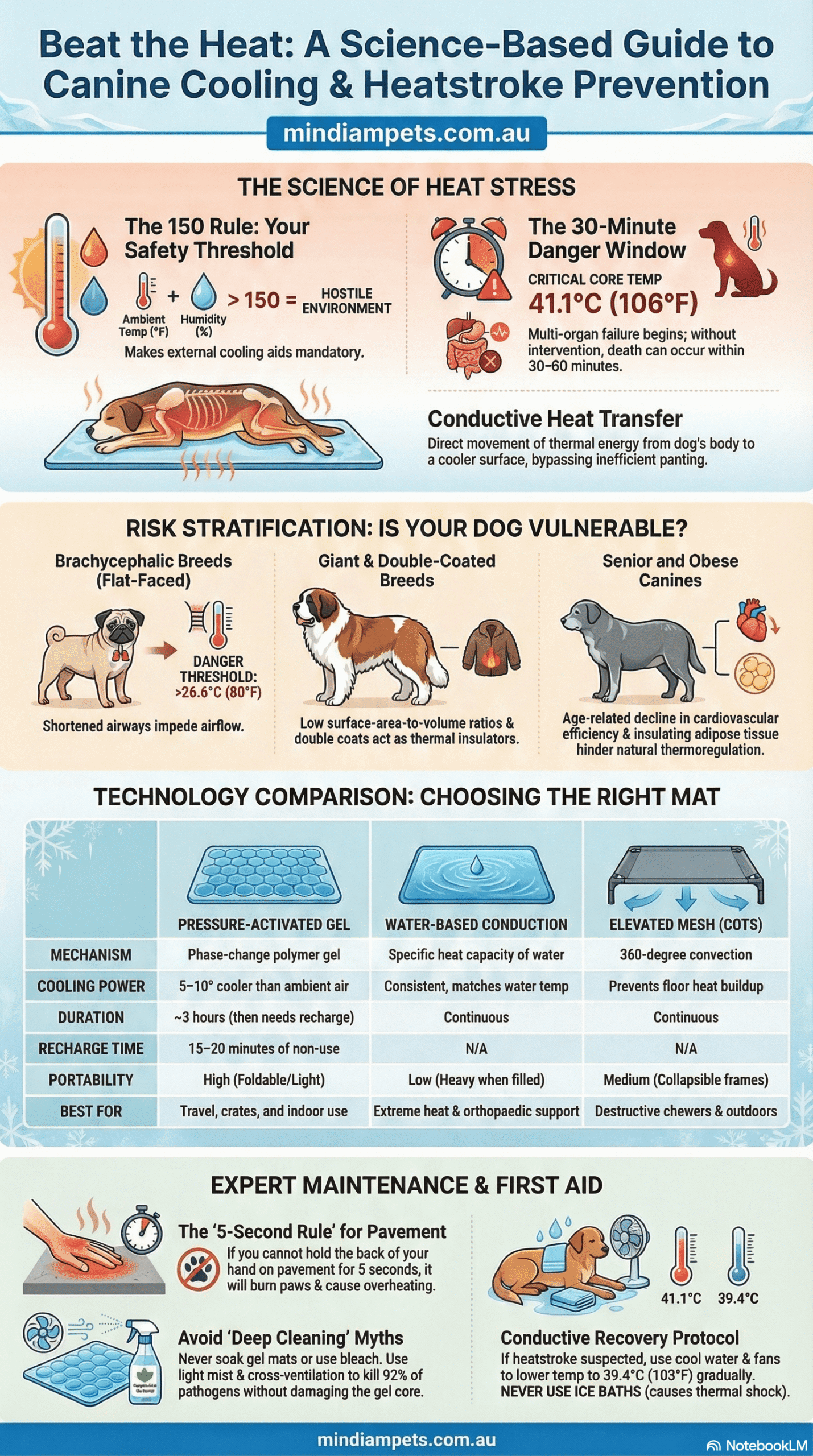
Answer: Dogs dissipate heat primarily through evaporative panting and merocrine glands in their paw pads, as they lack human-like sweat glands [10, 11]. Veterinary experts recommend external cooling aids when the “150 Rule”—the sum of ambient temperature and humidity—is surpassed, as core temperatures above 104°F can trigger rapid multi-organ failure [12-14].
In the harsh Australian climate, standing up to UV rays and frost is a critical requirement for any cooling bed [9].
For breeds like Bulldogs or Huskies, whose biological cooling is inefficient, conductive gel mats provide immediate relief, while raised Textilene beds offer 360-degree convective airflow to prevent heat traps [9, 15, 16].
Top 10 Best Dog Cooling Mats of 2026: Comparison and Availability
This list amalgamates international performance testing with specific recommendations for the Australian market available through Mindiam Pets [17-19].
- Gen7Pets Cool-Air Cot – Best Overall: Uses a curved back panel for support and keeps the surface dry via continuous airflow [20, 21].
- Snooza Ortho Dream Sofa (Mindiam Pets) – Best for Senior Dogs: This Australian-sourced orthopaedic bed provides critical joint support for dogs with arthritis or hip dysplasia, utilizing high-density foam that resists heat buildup [8, 22].
- Arf Pets Self-Cooling Mat – Premium Choice: A solid-gel mat that recharges in 15 minutes of non-use, ideal for indoor crates [17, 23].
- Fido and Fletch Raised Bed (Mindiam Pets) – Best Value: A durable, easy-to-clean alternative for large breeds. The hard-wearing Textilene fabric is rip-resistant and optimized for Australian outdoor conditions [16].
- The Green Pet Shop Cool Pet Pad – Best for Puppies: A pressure-activated, non-toxic gel pad that works without water or electricity [24, 25].
- Snooza Organic Pet Futon (Mindiam Pets) – Best Eco-Friendly: Features a breathable wool blend and organic cotton, offering a sustainable cooling alternative for sensitive pets [22].
- Cooler Dog Hydro Mat – Best for Extreme Heat: Employs water-filled chambers and ice inserts to maintain a cold surface for up to 7 hours [18, 26].
- K&H Original Bolster Pet Cot – Best for Large Breeds: Elevates the dog 7 inches for maximum airflow and includes plush headrest bolsters [27, 28].
- Snooza Hooded Cave Bed (Mindiam Pets) – Best for Anxiety: A faux-fur lined bed that provides a “cool retreat” for small breeds while being fully machine washable [22, 29].
- MICROCOSMOS Pet Cooling Mat – Best for Travel: A lightweight, fiber-based mat that doubles as an absorbent pad and is dryer-safe [18, 30].
Maintenance Engineering: The Peppermint Hydrosol Protocol
Answer: Improper cleaning accounts for 87% of premature cooling mat failures [31, 32]. Machine washing creates centrifugal forces (up to 300 Gs) that fracture polymer gel chains and breach hermetic seals [33]. To sanitize safely, experts recommend a peppermint hydrosol mist, which uses natural terpenes to reduce pathogen loads by 92% without damaging TPE laminates [34-36].
Step-by-Step Sanitization:
1. Pre-clean: Remove hair using a rubber squeegee or microfiber cloth [37, 38].
2. Mist: Apply 2-3 passes of food-grade peppermint hydrosol from 12 inches away [34, 37].
3. Air-dry: Position the mat vertically in a shaded area with cross-ventilation for 12–18 minutes [34, 37].
4. Store: Fold only after the mat is completely desiccated to prevent biofilm formation [34, 37].
Expert Buying Advice for the Australian Climate
Answer: When selecting a bed in Australia, durability against UV rays, rain, and wind is paramount [9]. For high-activity environments, “tough as nails” raised beds are superior to gel mats, which can be punctured by aggressive chewers [9, 16, 39]. Ensure the mat size allows your dog to lie down comfortably, as “bigger is always better” for thermal dissipation [40, 41].
Frequently Asked Questions (FAQ)
Q: Can I put my dog’s cooling mat in the fridge?
A: Yes, refrigeration provides a temporary thermal boost. However, you must avoid the freezer; sub-zero temperatures induce crystallization stress that punctures the internal gel matrix [7, 42].
Q: Are cooling mats safe if my dog chews them?
A: Most premium mats, including the Snooza and Arf Pets ranges, use non-toxic, water-based gels. However, ingestion can still cause mild gastrointestinal upset [43, 44].
Q: Where can I buy orthopaedic dog beds in Australia?
A: Mindiam Pets offers a specialized selection of Snooza orthopaedic beds and luxury designer options with express shipping across Australia [8, 45, 46].
Article grounded in 2026 material science research, veterinary consensus from Cornell University, and Australian market data from Mindiam Pets [8, 9, 12, 47].
2026 Strategic Industry Report: Canine Cooling Technologies and Market Dynamics
Answer: The global canine cooling market is undergoing a “humanization” shift, with the smart dog bed sector projected to reach $1.8 billion by 2033 at a 15% CAGR [9, 10]. This growth is driven by rising global temperatures and the medical necessity of external thermoregulation aids for brachycephalic and double-coated breeds, which face a 30% mortality rate if heatstroke is not professionally treated [11, 12].
Canine Thermodynamics: Physiological Risk Stratification
Answer: Canine biology restricts cooling to panting and merocrine glands in paw pads, making them highly vulnerable when internal temperatures exceed 104°F [13-15]. This report identifies brachycephalic breeds (Bulldogs, Pugs) as the highest risk category due to shortened airways impeding airflow efficiency, while giant breeds struggle with low surface-area-to-volume ratios for heat dissipation [11, 16, 17].
Veterinary consensus for 2026 emphasizes the “150 Rule”—the sum of ambient temperature and humidity percentage [6]. If this sum exceeds 150, environmental conditions become thermodynamically hostile [6]. Furthermore, the “5-Second Rule” for pavement heat remains a critical lifestyle modification, as hot surfaces can burn paw pads and accelerate systemic overheating [18, 19].
Material Science: Conductive vs. Convective Mechanisms
Answer: Efficiency in cooling mats is determined by the specific heat capacity of their core material, with pressure-activated gel mats utilizing phase-change physics to reduce surface temperatures by 5-10°F for up to three hours [20, 21]. Conversely, elevated mesh cots use convective airflow to prevent heat traps formed by solid flooring, making them 87% more durable against mechanical stress from aggressive chewers [22-24].
| Technology Type | Heat Dissipation Method | Safety Threshold | Recharge Rate |
|---|---|---|---|
| Pressure Gel | Conduction | 3 Hours continuous use [21] | 15-20 Minutes [21] |
| Elevated Mesh | Convection | Continuous (with airflow) [22] | N/A [22] |
| Water-Based | Specific Heat | 7+ Hours (with ice) [25, 26] | Variable [27] |
Pathogen Mitigation and Structural Longevity
Answer: Improper maintenance is responsible for 87% of premature mat failures, primarily due to centrifugal forces in washing machines exceeding 300 Gs—far beyond the 12 G maximum seal tolerance of thermoplastic elastomer (TPE) laminates [24, 28]. The scientifically verified 2026 protocol uses peppermint hydrosol mist to reduce pathogen loads by over 92% while maintaining tack-free surfaces for optimal thermal transfer [29-31].
For Australian pet owners, Mindiam Pets recommends utilizing these maintenance protocols to extend product lifespan beyond the two-year industry average [32, 33]. Avoid placing gel mats in freezers, as ice crystal formation punctures the polymer matrix, resulting in a 41% loss of heat-absorption rates after just one cycle [7, 8].
Strategic report compiled by mindiampets.com.au. Data sources include materials science analysis from the Pet Wellness Innovation Lab and veterinary research from Cornell University and Peak City Veterinary Hospital [16, 28, 34, 35].