

Dog Collar Guide: Types, Sizing and How to Fit a Collar
Get our free Pet Care Starter Checklist
A printable checklist for dogs and cats, plus practical care tips and new arrivals by email.
No spam. Unsubscribe anytime. | Or see our monthly pet box →
A dog collar is a strap that goes around your dog’s neck. It holds your dog’s ID and registration tags, and gives you a place to clip a lead. A good collar fits snugly, sits flat and does not rub. This guide covers the main collar types, how to measure your dog, how to check the fit, and the dog collars we stock.
Key takeaways
- Fit matters most. RSPCA Australia says you should be able to slide two fingers comfortably under the collar.
- A collar is the usual place for ID. In NSW, the Office of Local Government says all dogs except working dogs must wear a collar or tag showing their name and your address or phone number when outside your property.
- Puppies grow fast. RSPCA Australia says to check a puppy’s collar fit at least a few times a week.
- Skip collars that hurt. The Australian Veterinary Association says collars designed to inflict pain, discomfort or fear should not be used, and prong collars must not be used under any circumstances.
What is a dog collar used for?
A dog collar has three main jobs. It carries your dog’s ID and council tags, gives you a ring for the lead, and helps you keep hold of your dog in a hurry. Most everyday collars are flat collars with a buckle and a D-ring. RSPCA South Australia says the only collars it recommends are flat collars.
A collar is not always the best choice for walks. RSPCA Australia says gear that fits around the chest is better for walking and training, because it stops a dog pulling on and possibly hurting its neck. Many owners keep a flat collar on for ID every day and use separate walking gear. RSPCA South Australia suggests the same approach. See our guide to dog walking gear if you are choosing some.
Dog collars we stock: quick comparison
The table below compares the dog collars, headcollar and night light we stock, so you can match one to your dog. The features and neck sizes come from each product page on our site. Measure your dog’s neck first, then pick the size range that includes that number.
| Product | Key feature (from product page) | Neck sizes | Best for |
|---|---|---|---|
| Dan & Sam Vegan Leather Dog Collar | Vegan leather, buckle and D-ring | Small 20–30cm, Medium 30–40cm, Large 40–55cm | Everyday wear, easy wipe clean |
| Beau Pets Neoprene Dog Collar | Nylon with soft neoprene lining, chrome-plated fittings | 40cm to 70cm | Medium to large dogs, active dogs |
| Cocopup London Dinopaws Dog Collar | Neoprene padding, plastic buckle, D-ring | XS 23.5–28cm to L 46–71cm | Small to large dogs who like a fun print |
| Puppy Collar & Lead set | Collar and lead set, snap-fit buckle, adjustable | Adjustable | Puppies and first walks |
| Pet LED Safety Necklace | Rechargeable light, about 3 hours running time | 69cm, cut to size | Night walks (not a collar) |
| Halti Headcollar | Headcollar, padded and adjustable | Size 0 (29–36cm) to Size 5 (51–73cm) | Strong pullers, with a reward-based trainer |
Types of dog collars
There are six main types of dog collar, and they are not all safe. A flat collar is the everyday choice for ID tags. Some other types tighten around the neck or are designed to cause pain. The table below shows each type and what Australian animal welfare and vet groups say about it.
| Collar type | What it is | What the sources say |
|---|---|---|
| Flat collar | A strap with a buckle or clip and a D-ring | The only collar type RSPCA South Australia recommends |
| Martingale collar | A collar that tightens a little when the dog pulls | Less than ideal, but can be used for dogs with narrow heads such as greyhounds (RSPCA South Australia) |
| Headcollar | A strap around the nose and neck for steering | Should not be tried before loose-lead walking and other options (RSPCA Australia) |
| Choke chain or slip collar | A chain or loop that tightens around the neck | Must not be used, as they cause pain and distress (RSPCA Australia) |
| Prong or pinch collar | A collar with metal prongs | Must not be used under any circumstances (Australian Veterinary Association); illegal in Victoria (Agriculture Victoria) |
| Electronic collar | A collar that gives a shock, spray or tone | Should not be used; illegal in NSW (except containment collars), the ACT and SA, says the AVA |
The only collars we recommend at RSPCA South Australia are flat collars.
Tenelle, RSPCA South Australia
Vegan leather dog collar
The Dan & Sam Vegan Leather Dog Collar is made from vegan leather, an animal-free material with a leather look. Its product page says it has a strong buckle and D-ring, and is gentle on skin and fur. Wipe it clean with a damp cloth. It comes in black, blue, blush, red and tan.
The product page size guide says Small fits 20–30cm necks (such as Dachshunds and Jack Russells), Medium fits 30–40cm (such as Beagles and Kelpies) and Large fits 40–55cm (such as Labradors). It also says to supervise dogs wearing collars during play, to prevent snagging.
Neoprene dog collar
Neoprene is the soft, cushioned material used in wetsuits. The Beau Pets Neoprene Dog Collar is made from nylon and lined with soft neoprene, says its product page. It has chrome-plated fittings and eyelets for extra strength, and comes in sizes from 40cm to 70cm. It suits everyday walks, training and outings.
The Cocopup London Dinopaws Dog Collar also uses neoprene padding. Its product page says it has a strong plastic buckle and a D-ring for the lead, comes in sizes from XS (23.5–28cm) to L (46–71cm), and has widths from 1cm to 2.5cm. It has a mint green dinosaur print and is hand wash only.
Puppy collar
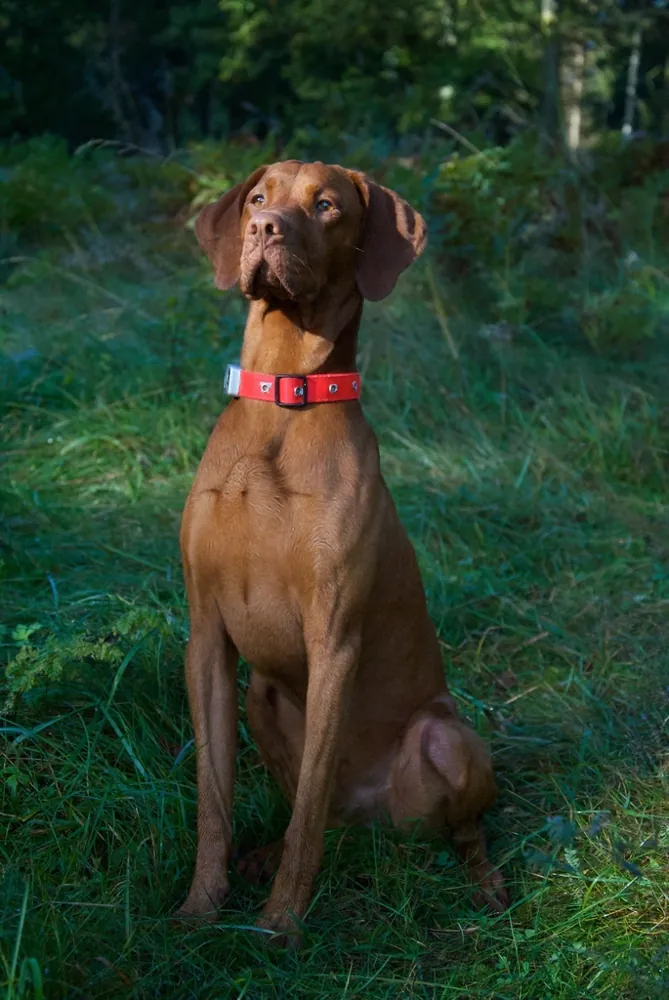
A puppy collar should be light, soft and adjustable. Start with short sessions at home and reward calm behaviour. RSPCA Australia says puppies grow extremely quickly, so check the fit of your puppy’s collar at least a few times a week.
If you have a medium or large breed puppy, RSPCA Australia says to start with a small collar and buy new ones as your dog outgrows them.
The Puppy Collar & Lead set comes with a matching lead. Its product page says it has a snap-fit buckle, adjustable straps and a lobster clasp. For more on settling a new puppy, see our puppy food guide and crate training guide.
How to measure a dog collar size
To find the right dog collar size, measure your dog’s neck with a soft tape, then check the size guide for the collar you like. Sizes vary between brands, so always use the guide on the product page rather than guessing by breed. Here is how to measure your dog in five steps:
- Use a soft tape measure. A piece of string and a ruler also works.
- Wrap it around the middle of the neck, where the collar will sit.
- Keep it snug but not tight, then note the number.
- Check that you can fit two fingers under the tape.
- Pick the collar size that includes your dog’s measurement, ideally near the middle of the range so you can adjust it.
Here is an example. If your dog’s neck measures 35cm, the Medium Dan & Sam collar (30–40cm) is a good match. A 45cm neck fits the Large size (40–55cm). For headcollars, the Halti Headcollar has six sizes from Size 0 (29–36cm) to Size 5 (51–73cm).
How to fit a dog collar properly
A well-fitted collar is snug enough that your dog cannot slip out, but loose enough to be comfortable. The rule of thumb is the two-finger test. Agriculture Victoria says to attach your dog’s council registration tag to a collar adjusted so you can fit 2 fingers comfortably between the collar and the neck.
Check the fit with these steps:
- Put the collar on and fasten the buckle.
- Slide two fingers flat under the collar. They should fit without forcing.
- Try to slide the collar over your dog’s head. If it slips off easily, tighten it.
- Watch for rubbing, hair loss or red skin under the collar over the next few days.
- Re-check the fit after a bath, a haircut or weight change.
Some dogs have a neck that is about as wide as their head, such as greyhounds and whippets. RSPCA Australia says these dogs need gear they can’t slip out of, so a collar alone is not enough for their walks.
The general rule of thumb for collars is that you need to be able to slide two fingers easily under the collar.
RSPCA Australia, Leading the way for dogs
Dog ID tags and the law in Australia
In most of Australia, your dog’s collar is where the law expects to see ID. In NSW, the Office of Local Government says all dogs, except working dogs, must wear a collar or tag outside your property. It must show their name and your address or phone number.
NSW dogs must also be microchipped by 12 weeks of age, or before being sold or given away, says the Office of Local Government.
In Victoria, Agriculture Victoria says all dogs 3 months of age and over must be registered with the local council. Victoria Legal Aid says it is an offence for a registered dog to be outside the owner’s property without its registration tag, unless an exemption applies. Rules differ between states and councils, so check with your local council.
ID tags make a real difference when a dog goes missing. A US survey by the ASPCA of 1,015 pet-owning households found that 14% of dog owners had lost a dog in the past five years. Of those lost dogs, 93% were recovered. 49% of owners found their dog by searching the neighbourhood, and 15% of the dogs were recovered because they were wearing an ID tag or had a microchip. Only 6% of dog owners found their lost dog at a shelter.
[The research] highlights the importance of ID tags and other forms of identification to ensure the quick return of lost pets.
Dr Emily Weiss, ASPCA
Microchips help too, as long as the details are current. A study of 7,704 microchipped animals in 53 US animal shelters, published in the Journal of the American Veterinary Medical Association, found stray dogs with microchips went home 52.2% of the time, compared with 21.9% for all stray dogs. Shelters found the owners of 74.1% of microchipped stray dogs. When owners could not be found, the main reason was an incorrect or disconnected phone number (35.4%).
The chip is only as good as my ability as a pet owner to keep my information up to date in the registry.
Linda Lord, lead author, quoted by dvm360
A tag and a microchip work together. A tag lets anyone who finds your dog call you straight away. A microchip is a back-up if the collar comes off. Keep your contact details up to date on both.
What to look for when buying a dog collar
Your dog may wear a collar every day, so comfort and safety matter more than looks. The right dog collar fits your dog’s neck size, suits how active your dog is, and is easy to keep clean. Use this simple checklist when you shop, and check each product page for sizes and care notes:
- Size: the collar’s size range should include your dog’s neck measurement.
- Material: nylon is light, neoprene adds padding, and vegan leather wipes clean.
- Width: a narrow collar suits small dogs and puppies; bigger dogs usually wear a wider collar.
- Hardware: check the buckle and D-ring are strong and sit flat.
- Easy to clean: check the care notes, such as wipe clean or hand wash.
- Visibility: a reflective lead or a clip-on light helps on early morning or evening walks.
For night walks, the Pet LED Safety Necklace is a light that loops around your dog’s neck. Its product page says it is rechargeable by micro USB, runs for 3 hours, can be cut to size, and is not suitable as a collar, so use it with a normal collar. The Halti Black Lead is 1.2m long with a reflective weave and a padded handle, says its product page.
Collar vs harness: which is better for walks?
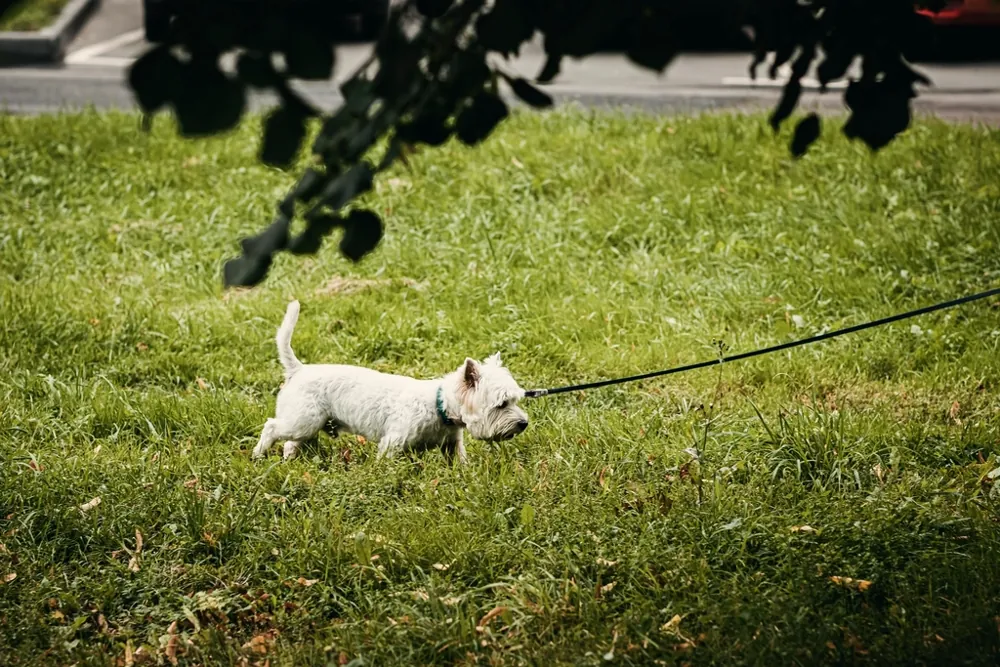
For most dogs, a collar is for ID, and walks are easier in gear that fits around the chest. RSPCA Australia says this is ideal for walking and training because it prevents dogs pulling on and possibly hurting their neck. RSPCA Pet Insurance says calm or older dogs who already walk nicely on a lead may be comfortable in a collar.
If your dog pulls hard, RSPCA Australia says a front-attach style is the most appropriate tool for most dogs. It says head collars should not be tried without first trying loose-lead walking and that front-attach option, and dogs have to be trained to accept them. If a reward-based trainer recommends one, we stock the Halti Headcollar and the Beau Pets Gentle Leader Headcollar.
For recall practice in a safe, open space, a long line gives your dog room while you keep control. The Pet Recall Training Lead is 10 metres long with a maximum weight capacity of 24kg, says its product page. It also warns that the metal ring on your dog’s collar must be strong enough to take the full force of your dog.
Collars to avoid
Some collars are designed to work through pain or fear. The Australian Veterinary Association says collars designed to inflict pain, discomfort or fear to change behaviour should not be used on dogs, and gives electronic, citronella and choke collars as examples. It says positive reinforcement training makes this equipment unnecessary.
- Choke chains and slip collars: RSPCA Australia says they must not be used, as they cause pain and distress and can damage the neck.
- Prong or pinch collars: the AVA says they must not be used under any circumstances. Agriculture Victoria lists using a prong collar as illegal in Victoria.
- Electronic collars: the AVA says their use is illegal in NSW (except containment collars), the ACT and South Australia.
If your dog pulls, jumps or lunges, the AVA suggests getting help from a vet or a qualified force-free, positive-reinforcement trainer.
How often should you replace a dog collar?
Replace a collar when it is worn, damaged or too small. Check it every week or so for fraying, cracks, a loose buckle or a bent D-ring, because a worn collar can snap during a walk. The Dan & Sam product page says to inspect the buckle and D-ring regularly for safety.
Puppies will need a few collars as they grow, so check their fit at least a few times a week, as RSPCA Australia advises.
FAQ: specific questions about dog collars
Dog owners often ask the same questions about collars, from sizing and fit to the law on ID tags. The short answers below follow the RSPCA, Australian Veterinary Association and state government advice cited in this guide. Check with your local council for the rules where you live.
What size collar does my dog need?
Measure the middle of your dog’s neck with a soft tape, then pick a collar whose size range includes that number. RSPCA Australia says you should be able to slide two fingers comfortably under the collar once it is on. Sizes vary by brand, so check each product’s size guide.
How tight should a dog collar be?
Snug, but not tight. You should fit two fingers under it. Agriculture Victoria says to adjust the collar so you can fit 2 fingers comfortably between the collar and your dog’s neck. If it slides over your dog’s head, it is too loose.
Does my dog have to wear a collar in Australia?
The rules depend on your state and council. In NSW, all dogs except working dogs must wear a collar or tag showing their name and your address or phone number when outside your property. In Victoria, a registered dog must wear its council registration tag outside the owner’s property unless an exemption applies.
Is a collar or harness better for walking?
For most dogs, gear that fits around the chest is better. RSPCA Australia says it is ideal for walking and training because it stops dogs pulling on and hurting their neck. Many owners keep a flat collar on for ID and use separate gear for walks.
What collar is best for a puppy?
A light, soft, adjustable flat collar. RSPCA Australia says to check the fit of your puppy’s collar at least a few times a week, because puppies grow extremely quickly. For a medium or large breed puppy, start with a small collar and size up as your puppy grows.
Are choke chains and prong collars safe?
No. RSPCA Australia says check chains and prong collars must not be used, as they cause pain and distress and can damage the neck. The AVA says prong collars must not be used under any circumstances, and Agriculture Victoria lists using a prong collar as illegal in Victoria.
Should my dog wear a collar at home?
Many owners keep a collar on so ID is always there. The Dan & Sam product page says to supervise dogs wearing collars indoors or during play to prevent snagging. Check your crate and play areas for anything a collar could catch on.
Shop dog collars and walking gear
You can see every dog collar, lead and walking option in our leads and collars range. Our pet supplies checklist lists the basics to have ready for a new dog, including a collar and ID tag. Our monthly pet box delivers pet supplies to your door each month.
References
The advice in this guide comes from the Australian animal welfare, veterinary and government sources below, plus two US studies on lost pets. Product details, sizes and care notes come from each product page on our site. Rules on ID tags differ by state and council, so check locally.
- RSPCA Australia, What equipment should I use when teaching my dog or puppy to walk on a leash?
- RSPCA Australia, Leading the way for dogs
- RSPCA South Australia, walking gear for your dog and the must-avoid collars and leads
- RSPCA Pet Insurance, choosing the right walking gear for your pup
- Australian Veterinary Association, Use of behaviour-modifying collars on dogs
- NSW Office of Local Government, Microchipping
- Agriculture Victoria, Legal requirements overview for dog owners
- Victoria Legal Aid LawHub, Identification of pets
- ASPCA, How many pets are lost? How many find their way home?
- Lord et al., Characterization of animals with microchips entering animal shelters, JAVMA
- dvm360, Microchipped pets returned home three out of four times

During veterinary school, he contributed to projects involving species such as hammerhead sharks, Shark Bay mice, woylies, mulgara, and kangaroos, gaining valuable hands-on experience in wildlife health and preservation.




3 comments